Overnight Collapse: The Brand Impact of Data Breaches
March 17, 2026
Why Your EMR is a Goldmine for Hackers
March 19, 2026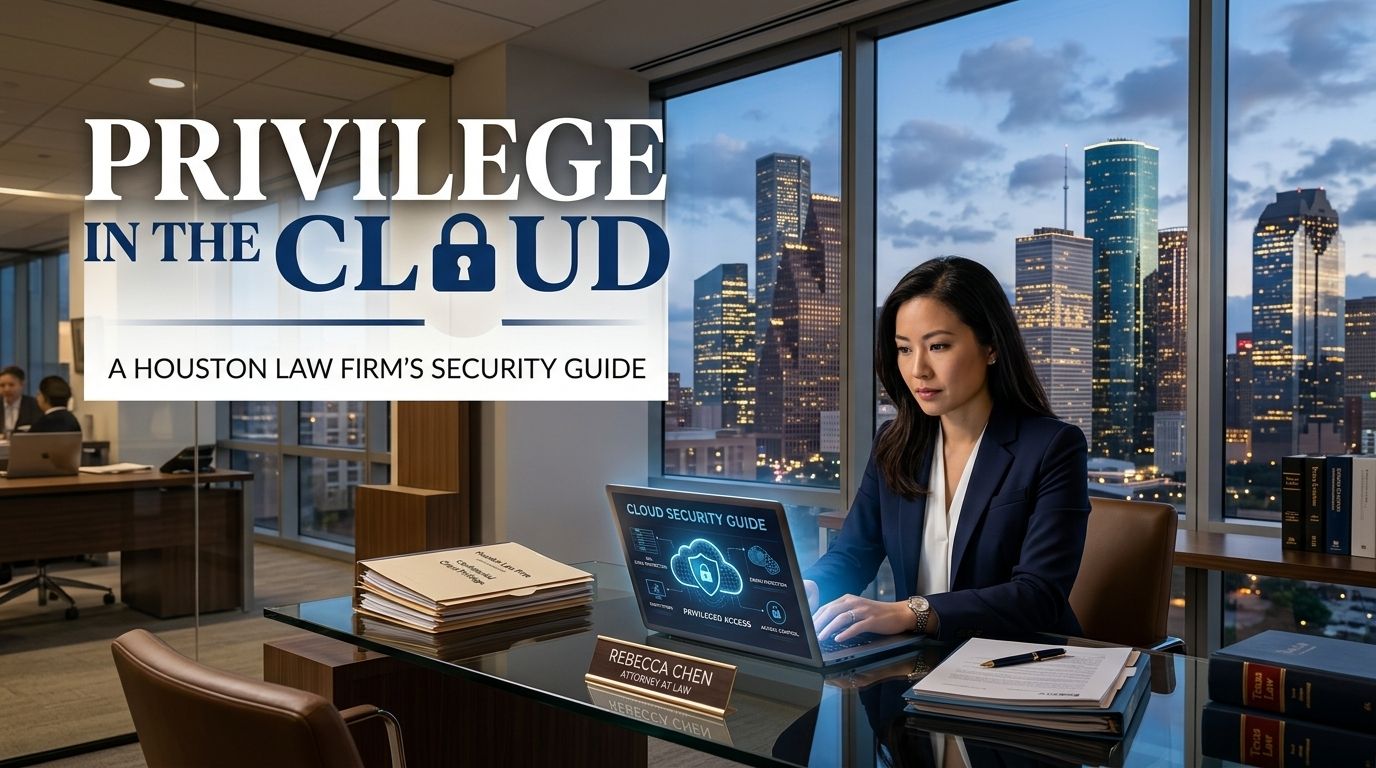
The Digital Gavel: Protecting Attorney-Client Privilege in an Era of Borderless Data
A Legal Ethics & Security Briefing by Krypto IT | Fortifying the Houston Bar Against Digital Intrusion
For the Houston attorney, the “sanctity of the file” used to be guaranteed by a locked cabinet and a heavy mahogany door. In 2026, that door has been replaced by an IP address, and the cabinet lives in a multi-tenant cloud server. While the medium has changed, the ethical mandate has not: The duty to maintain client confidentiality remains absolute.
However, the “Reasonable Care” standard is shifting. In a post-paper world, simply having a password is no longer considered “reasonable” by the State Bar or by sophisticated corporate clients in the Energy Corridor. At Krypto IT, we’ve seen that for a modern law firm, cybersecurity is the new “Attorney-Client Privilege.” If you cannot secure the data, you cannot guarantee the privilege.
1. The “Ghost in the Machine”: Hidden Risks to Privilege
In a digital environment, privilege is leaked in ways that never happened in the paper era. We’ve identified three primary “leakage points” that Houston firms must address:
- Metadata Trails: Every Word document and PDF sent to opposing counsel contains a digital history—who edited it, when, and sometimes even “tracked changes” that were supposed to be deleted.
- Discovery Vulnerabilities: Large-scale e-discovery requires moving massive amounts of data to third-party vendors. If that “chain of custody” isn’t digitally encrypted, the privilege is at risk.
- Mobile Advocacy: Attorneys checking sensitive case files on public Wi-Fi at Hobby Airport or from a home office in Sugar Land are often unknowingly broadcasting their clients’ secrets to the world.
2. The Ethics of Encryption:
E = C/A
To simplify the technical burden for our legal partners, we use the Ethical Security Ratio (E):
E = Complexity of Encryption (C)/Ease of Accessibility (A)
In the past, firms sacrificed C (Security) for A (Accessibility) because high-level encryption was “too hard to use.” In 2026, this is a failing grade. With Krypto IT’s implementation of Zero Trust Architecture, we ensure that C is maximized through background encryption and biometric identifiers, so A remains seamless for the attorney while remaining impenetrable to an unauthorized third party.
3. The “Work Product” of the Future: Secure Collaboration
The modern Houston firm isn’t a silo; it’s a collaborative hub. Co-counsel, expert witnesses, and court reporters all need access to the file.
The “Old Way” was emailing attachments—a practice that is now a massive security liability. The “New Way” is the Secure Data Room. By hosting case files in a centralized, encrypted environment where you control exactly who can view, download, or print a document, you maintain a “Digital Fence” around your work product.
Krypto IT specializes in building these “Legal Vaults” that allow for high-speed collaboration without ever surrendering control of the underlying data.
4. Incident Response: The “Ethical 72 Hours”
Under modern data breach notification laws and ethical guidelines, “I didn’t know we were hacked” is no longer an acceptable defense. You have an ethical obligation to monitor your systems for intrusion.
If a breach occurs, the clock starts immediately. You must be able to determine:
- Exactly which client files were accessed.
- If any privileged communication was exfiltrated.
- How to notify the affected parties without causing undue panic or compromising the ongoing litigation.
Without the 24/7 monitoring provided by a Security Operations Center (SOC), a firm is essentially flying blind. Krypto IT provides that “Digital Sentry,” ensuring that if a “ghost” enters your machine, we catch them before the privilege is waived.
How Krypto IT Protects the Houston Bar
We don’t just manage your IT; we protect your license and your legacy. Krypto IT provides Houston law firms with a tailored Legal Security Stack:
- Privilege Audits: Identifying where your sensitive case data is “leaking” through unencrypted channels.
- Zero-Friction MFA: Implementing biometric security that protects the file without slowing down the attorney.
- Secure Remote Advocacy: Ensuring your home office and mobile devices meet the same security standards as your downtown headquarters.
- Encrypted Communication Portals: Moving client interaction away from vulnerable email and into secure, branded portals.
Conclusion: The New Standard of Care
In 2026, the most successful firms in Houston won’t just be the best at litigation; they will be the most trusted stewards of their clients’ digital lives. Cybersecurity is no longer an “IT issue”—it is the foundation of the modern legal practice.
Is your firm meeting the 2026 standard of “Reasonable Care”? Contact Krypto IT today for a “Legal Privilege Security Briefing” and let’s secure your practice.