Anonymous Reporting: Empowering Staff to Flag Flaws
September 14, 2026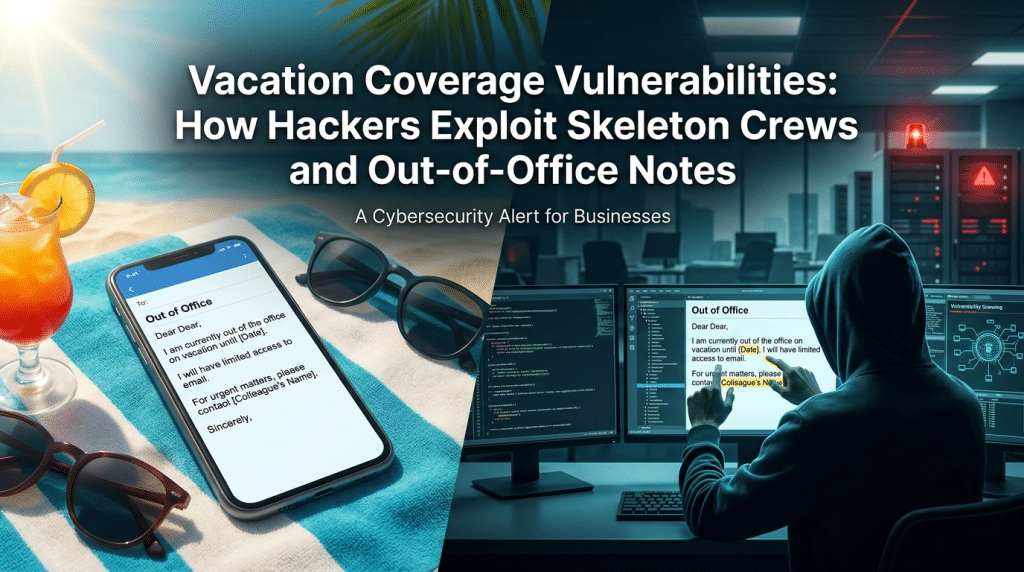
Vacation Coverage Vulnerabilities: How Hackers Exploit Skeleton Crews and Out-of-Office Notes
During major holiday seasons, summer breaks, and extended holiday weekends, corporate priorities naturally shift. Offices quiet down, inboxes slow, and employees step away to recharge. Across organizations of every size, departments operate on skeleton crews—minimal staffing models where remaining team members cover unfamiliar responsibilities, absorb surging workloads, and manage operational handoffs on the fly.
While this slowdown is a welcomed pause for employees, cybercriminals view these low-traffic periods as their most lucrative operational windows.
Threat actors understand corporate calendars intimately. They know that during holiday weekends, emergency change-approval processes become lax, senior decision-makers are difficult to reach, and frontline technical coverage is stretched thin.
By weaponizing the routine details found inside out-of-office autoresponders and exploiting the pressure placed on temporary coverage teams, attackers execute high-impact intrusions that often go unnoticed until standard operations resume.
The Intelligence Goldmine: Out-of-Office Autoresponders
The humble out-of-office (OOO) email autoresponder is one of the most routinely abused reconnaissance tools in modern social engineering. In an effort to be helpful to clients and colleagues, employees frequently craft detailed autoresponders that provide everything an attacker needs to execute a targeted compromise:
- Exact Dates of Absence: Telling an external sender, “I will be offline with limited mobile service through July 10th,” gives an attacker an exact window during which they can impersonate that executive without fear of the real person answering an internal verification call.
- Organizational Hierarchy and Delegation Lines: Messages stating, “For emergency wire approvals or urgent invoice inquiries, please contact Sarah in finance,” map out internal approval channels and provide attackers with a primed target.
- Personal and Travel Details: Details mentioning specific conferences, international destinations, or family resorts give attackers conversational ammunition to craft hyper-convincing phishing messages to co-workers, making urgent requests sound completely legitimate.
Armed with this information, social engineers deploy Business Email Compromise (BEC) campaigns targeting the covering employee. Posing as an executive known to be unreachable, they send urgent requests for invoice approvals, emergency vendor wire transfers, or immediate payroll adjustments—stressing that poor cell service prevents them from jumping on a call.
Why Skeleton Crews Weaken Security Defenses
Beyond email reconnaissance, reduced staffing during vacation windows compromises an organization’s core technical and operational posture:
1. Alarm Fatigue and Alert Overload
Security Operations Centers (SOCs) and internal IT teams monitor thousands of automated security alerts daily. When a skeleton crew operates at half capacity, alert triage times slow down significantly. Attackers deliberately schedule automated network scans, brute-force attacks, or data staging operations at 2:00 AM on a Sunday or during a holiday weekend, banking on the fact that an overworked on-call engineer will miss anomalous telemetry.
2. The Urgency Trap for Covering Staff
Covering colleagues are often unfamiliar with the subtle procedural nuances of a colleague’s role. An administrative assistant temporarily managing an executive’s calendar or an junior accountant approving payment runs wants to be helpful and avoid causing delays. When presented with an urgent, time-sensitive request that appears to come from upper management, covering personnel are far more likely to bypass verification protocols to “keep business moving.”
3. Slower Incident Containment Windows
When a ransomware incident or data breach occurs during regular business hours, incident response plans execute rapidly because all system owners are readily available. During holiday periods, reaching critical stakeholders—database administrators, compliance officers, and executive leadership—can take hours instead of minutes. This containment delay gives attackers the dwell time needed to escalate privileges, disable cloud backups, and encrypt active file systems.
Hardening Your Organization Against Vacation Vulnerabilities
Mitigating vacation-related security risks requires proactive operational planning and clear technical guardrails before the vacation season starts:
1. Standardize and Restrict OOO Autoresponders
Enforce a corporate policy regarding out-of-office notifications.
- Configure mail servers to send external autoresponders solely to recognized senders or contacts, rather than anyone emailing from the public internet.
- Strip out internal hierarchy details, direct mobile numbers, and specific travel destinations. A secure OOO message should state only that the sender is away and direct inquiries to a centralized departmental inbox (e.g., support@company.com or invoices@company.com) rather than a specific individual’s personal address.
2. Enforce Strict Out-of-Band Verification Rules
Reiterate that emergency exceptions for financial transactions or sensitive data releases do not exist—especially when senior leadership is out of the office. Mandate that any request to alter banking details, execute wire transfers, or change vendor routing must be verified through a secondary, pre-arranged out-of-band channel, regardless of the stated urgency.
3. Plan Redundant Escalation and On-Call Trees
Never rely on a single on-call IT administrator or security analyst during holiday periods. Establish clear, secondary and tertiary escalation contacts with verified contact numbers. Ensure that on-call personnel have immediate, secured remote access credentials and pre-authorized containment authority to isolate compromised workstations or suspend accounts without waiting for executive sign-off.
4. Implement Change Freezes During Major Holiday Windows
Declare formal IT change freezes across production infrastructure during high-travel holiday windows. Restricting non-critical updates, network reconfigurations, and firewall adjustments minimizes operational confusion, allowing on-call staff to focus strictly on genuine anomaly detection.
Safeguard Your Business Year-Round with Krypto IT
Cyber threats do not take vacations. Protecting your corporate environment requires continuous, 24/7/365 vigilance that keeps systems defended even when your core team is away.
At Krypto IT, we provide Houston-area and remote-first businesses with managed IT services, around-the-clock Security Operations Center (SOC) monitoring, and proactive incident response planning that protects your operational continuity through every season.
Are vacation coverage gaps and unmanaged autoresponders leaving your business exposed? Contact Krypto IT today to schedule a comprehensive operational security and incident readiness review.