UPS Protection: Safeguarding Tech from Power Surges
July 30, 2026
Physical Keyloggers: The Sneaky USB Hardware Threat
August 4, 2026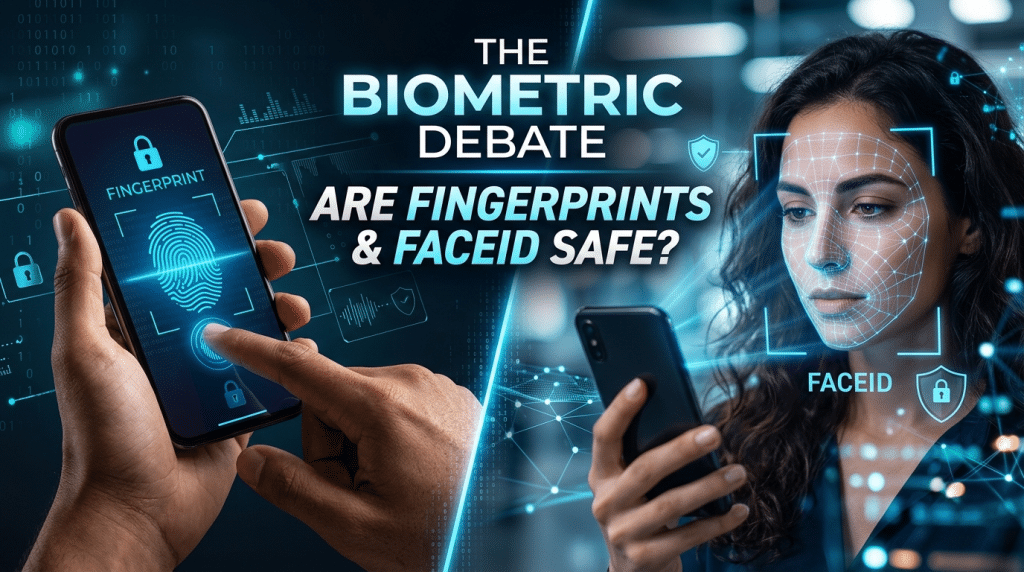
The Biometric Debate: Are Fingerprints and FaceID Safe for Corporate Devices?
As businesses across Houston push toward modernizing their IT infrastructure, traditional passwords are increasingly recognized as a major vulnerability. Weak passwords, credential reuse, and phishing campaigns remain primary drivers of corporate data breaches. In response, many small and mid-sized businesses (SMBs) are adopting biometric authentication—such as Apple’s FaceID, Windows Hello, and fingerprint scanners—to secure laptops, mobile devices, and cloud applications.
However, moving to biometrics raises an important question for business owners and IT leaders: Are biological traits like fingerprints and facial scans genuinely safe for corporate environment security, or do they introduce risks of their own?
The Advantages of Biometric Security
There is no denying that biometric authentication provides significant security advantages over traditional, static passwords:
- Phishing Resistance: Standard passwords can be tricked out of employees through sophisticated spoofing sites or social engineering attacks. Biometrics tied to local hardware (using standards like FIDO2/WebAuthn) require physical presence at the registered endpoint, neutralizing remote credential harvesting.
- Elimination of Weak Passwords: Employees naturally struggle to memorize dozens of long, unique passwords. Biometrics replace complex text strings with a touch or a glance, closing gaps left by weak or reused corporate passwords.
- Frictionless User Experience: Faster sign-ins improve operational efficiency and reduce common help desk calls related to password resets, saving time and administrative overhead.
The Risks and Limitations of Biometrics
Despite its clear strengths, biometric technology is not a silver bullet. Understanding its limitations is essential for maintaining a defensive security posture.
Biometrics Cannot Be Reset
If a password is compromised in a data breach, your IT team can reset it within seconds. Biometric traits, however, are permanent. If a database containing raw biometric files is exposed, those identifiers are permanently compromised. Modern enterprise platforms mitigate this by storing mathematical representations (templates) inside encrypted hardware modules—like Apple’s Secure Enclave or a laptop’s TPM chip—rather than transmitting raw images over network connections.
Deepfakes and Presentation Attacks
With rapid advances in generative artificial intelligence, presentation attacks (spoofing) are becoming more sophisticated. High-resolution photos, 3D masks, and AI-generated media present challenges for entry-level facial recognition software. Business-grade biometrics must feature advanced “liveness detection” to verify that a real, living human is physically interacting with the sensor.
Legal and Compliance Mandates
Collecting biological data brings regulatory responsibilities. Data privacy frameworks mandate strict guidelines on how biometric templates are captured, stored, and deleted. Businesses operating in regulated verticals must ensure their biometric tools comply with relevant privacy standards to avoid severe compliance penalties.
Best Practices for Enterprise Deployment
Biometric authentication should never act as a single layer of security. To safely leverage biometrics across corporate endpoints, businesses should follow three core best practices:
- Enforce On-Device Processing: Verify that your hardware stores biometric templates strictly inside local secure chips (TPM / Secure Enclave) rather than syncing raw biometric data to central cloud databases.
- Use Biometrics as Part of MFA: Treat a fingerprint or facial scan as one factor of a robust Multi-Factor Authentication (MFA) framework—combining something the user is (biometrics) with something they have (a managed corporate device).
- Deploy Enterprise Mobility Management (EMM): Use device management tools to ensure biometric access can be remotely revoked if a laptop or phone is lost, stolen, or assigned to a departing employee.
Secure Your Business Identity with Krypto IT
Moving toward a passwordless environment can dramatically reduce your company’s attack surface, but implementation matters. Off-the-shelf consumer setups often lack the central oversight and policy enforcement required to keep business networks compliant and secure.
At Krypto IT, we help businesses implement secure identity management strategies—combining hardware-backed biometrics, Zero Trust access controls, and centralized endpoint management.
Ready to upgrade your access security while simplifying employee sign-ins? Contact Krypto IT today to schedule an identity security audit.