
IT Consulting Houston: Strategic Guidance to Fortify Your Business
January 25, 2026
In today’s digital landscape, a major IT disaster is no longer a matter of if, but when. One successful cyberattack or critical server failure can erase years of hard work, grinding your operations to a halt. Many businesses mistakenly believe a simple data backup is their safety net, but this is a dangerous assumption. A backup saves files, but only a partnership with a true disaster recovery company can save your business from the crippling cost of downtime.
But how do you choose the right partner? The market is filled with complex solutions and technical jargon, making it difficult to vet a provider’s claims and find a reliable service that fits your budget. The fear of making the wrong choice—and being left vulnerable when an incident occurs—is a major roadblock for many leaders.
This 2025 guide cuts through that confusion. We will give you a clear, actionable framework to evaluate potential partners, ask the right questions, and confidently select the company that will fortify your defenses. Let us empower you to build a resilient business with the peace of mind that comes from knowing you are prepared for anything.
What Is an IT Disaster Recovery Company (And What Isn’t)?
When a crisis strikes, you need immediate, effective action. But if you’re searching for a disaster recovery company, you’re not looking for someone to clean up after a flood. You’re looking for a strategic partner to resurrect your digital operations after a technological catastrophe.
Modern disasters are digital: ransomware, catastrophic server failure, or widespread data corruption. An IT DR company is your first line of defense. Their mission is to restore your critical technology infrastructure with one clear goal: minimizing crippling downtime and devastating data loss. They fortify your business against the threats you can’t see, ensuring you can get back to work fast.
IT Disaster Recovery vs. Physical Disaster Recovery
It’s crucial to understand the difference. Physical disaster recovery deals with tangible assets—rebuilding an office after a storm or salvaging equipment from a fire. IT disaster recovery focuses on your most valuable intangible assets: your data, applications, networks, and servers. A ransomware attack can paralyze your business without a single window being broken, which is why you need a dedicated IT DR plan even if your physical office is perfectly secure.
The Core Mission: Business Continuity
A robust DR plan doesn’t exist in a vacuum. It is a critical component of a larger strategy called Business Continuity Planning (BCP). Think of BCP as the master playbook for keeping your entire business operational through a crisis. Within that playbook, the chapter on restoring technology is your DR plan. It’s the tactical, hands-on process that answers the vital question: “How do we get our systems back online?”
Key Differences: Data Backup vs. Disaster Recovery
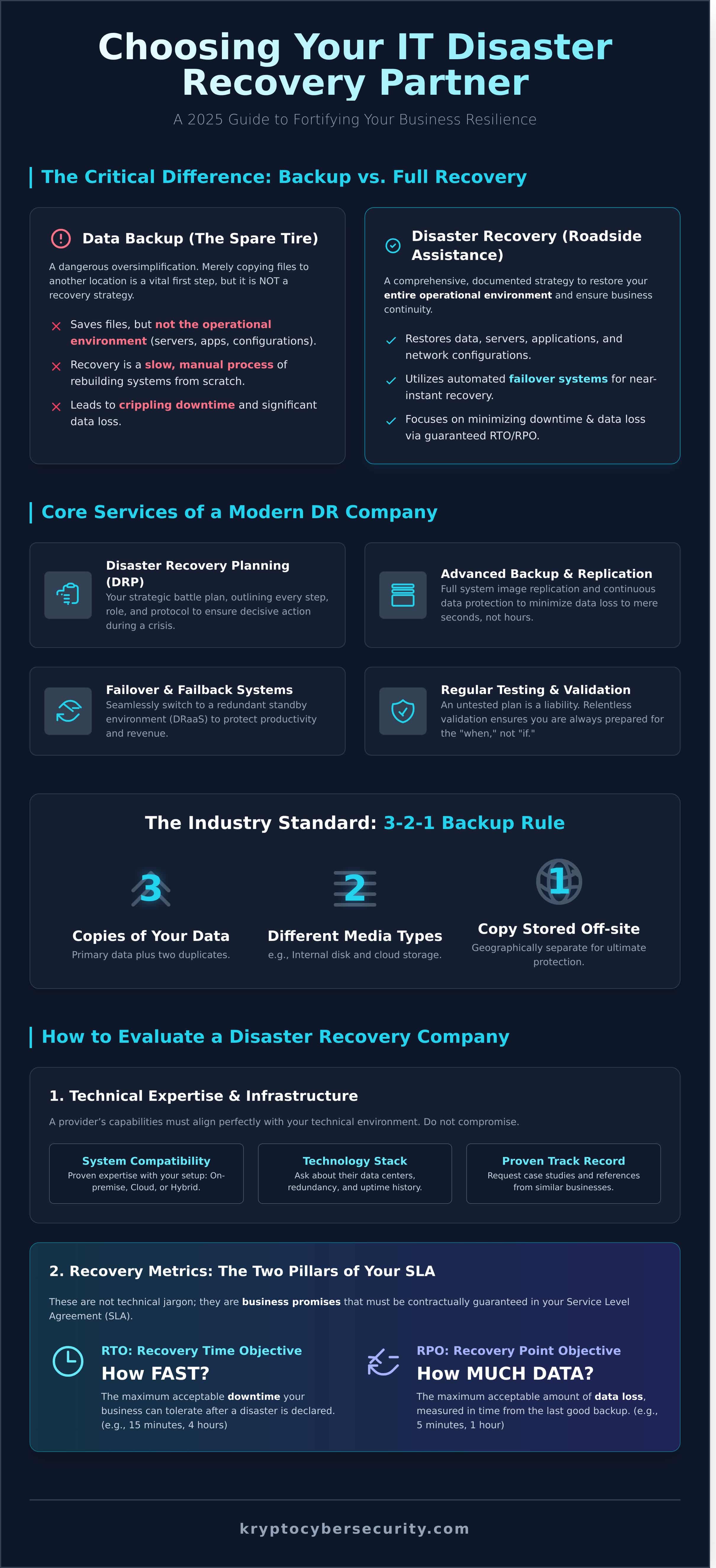
Many businesses mistake simple data backup for a complete recovery solution. This is a dangerous oversimplification. Backup is merely the act of copying files to another location—a vital first step, but not a strategy. A comprehensive Disaster recovery plan is a documented process to restore your entire operational environment. It includes not just your data, but the servers, applications, and network configurations your team needs to actually use that data. Having a backup is like owning a spare tire; having a DR plan is the full roadside assistance service that gets you back on the road.
Core Services of a Modern Disaster recovery Company
Effective business continuity is not about recovering data after a disaster; it’s about ensuring the disaster has minimal impact in the first place. A modern disaster recovery company delivers far more than a simple “restore” button. It builds a comprehensive shield around your operations through an integrated stack of services designed for proactive defense and rapid response. This is where the concept of Disaster Recovery as a Service (DRaaS) provides immense value, orchestrating these components into a seamless, managed solution.
Disaster Recovery Planning (DRP)
This is your strategic battle plan. A DRP is the foundational document that outlines every step, role, and protocol for responding to a crisis. It begins with a Business Impact Analysis (BIA) to identify your most critical systems and define acceptable downtime. We then establish clear communication chains and responsibilities. When an incident occurs, there is no guesswork—only decisive action.
Advanced Backup and Replication Solutions
Forget simple file backups. True resilience requires full system image replication and continuous data protection to minimize data loss to mere seconds, not hours. We fortify your data using the industry-standard 3-2-1 Rule to guarantee availability:
- Three copies of your data.
- On two different types of media.
- With one copy stored securely off-site in the cloud.
Failover and Failback Systems
When your primary systems go down, your business must stay up. A failover system automatically switches operations to a redundant, standby environment—often a cloud-based replica of your infrastructure (DRaaS). This transition is seamless, protecting your productivity and revenue. Once the primary site is restored and stable, a controlled failback process returns operations to normal without further disruption.
Regular Testing and Validation
An untested plan is not a plan; it’s a liability. We relentlessly validate your DRP through scheduled tests, from tabletop exercises that simulate a crisis response to full failover tests that prove the technology works as designed. A proactive disaster recovery company manages, documents, and refines this process, ensuring you are always prepared for the “when,” not “if.”
How to Evaluate a Disaster Recovery Company: A Checklist
When disaster strikes, your recovery is only as strong as the partner you’ve chosen. Selecting the right disaster recovery company goes far beyond comparing prices; it’s about entrusting your entire operation to their technology, expertise, and commitment. Use this checklist to cut through sales pitches and evaluate potential partners on what truly matters: their ability to get you back online when every second counts.
Technical Expertise and Infrastructure
A provider’s capabilities must align perfectly with your technical environment. A mismatch here guarantees failure. Do not compromise. Demand clear answers to these critical questions:
- System Compatibility: Do they have proven expertise with your specific setup, whether it’s on-premise servers, a fully cloud-based infrastructure, or a complex hybrid model?
- Technology Stack: What data centers and technologies do they use? Ask about redundancy, failover capabilities, and their own uptime history.
- Proven Track Record: Request case studies or references from businesses of a similar size and industry. A generic solution is not a real solution.
Recovery Metrics: RTO and RPO
These two metrics are the foundation of your recovery plan. They are not technical jargon; they are business promises that must be contractually guaranteed in your Service Level Agreement (SLA).
- Recovery Time Objective (RTO): How fast will you be back online? This defines the maximum acceptable downtime your business can tolerate, from minutes to hours.
- Recovery Point Objective (RPO): How much data can you afford to lose? This determines the maximum age of the files recovered from backup, defining the data loss window.
Security and Compliance Certifications
Your replicated data is a prime target for cybercriminals. Your recovery partner must be a fortress. Verify their security posture as rigorously as you would your own.
Ensure their data centers are compliant with relevant regulations for your industry (e.g., HIPAA, SOC 2, GDPR). Ask how they secure your data—both in transit and at rest—with robust encryption. A weak link in their security is a direct threat to your business continuity.
Support, Communication, and SLAs
During a crisis, you need expert support, not a ticket number. The quality of a disaster recovery company is revealed in its response to an emergency. The SLA must clearly define their obligations, including penalties for failure. Ask them directly: Is support available 24/7/365 from qualified engineers who can immediately begin the recovery process?
Before you can evaluate a partner, you must first understand your own weaknesses. Let us perform a comprehensive Cyber Risk Assessment to uncover your vulnerabilities and establish the precise recovery objectives your business needs to survive.
The True Cost of Downtime vs. The Investment in Recovery
Many business owners hesitate at the cost of business continuity, viewing it as an operational expense. This is a critical mistake. The reality is that a comprehensive recovery plan is not a cost center; it is an essential investment that protects your most valuable asset—your ability to operate. The true, devastating cost is found in unplanned downtime, which can cripple a business in a matter of hours.
Industry reports consistently show that a single hour of downtime can cost a small business thousands, if not tens of thousands, of dollars. When you compare that catastrophic loss to the predictable cost of a managed recovery service, the choice becomes clear. A single incident can easily cost more than years of proactive protection.
Calculating Your Cost of Downtime
Do you know what one hour of downtime costs your business? The calculation is brutally simple: Lost Revenue + Lost Productivity + Recovery Costs. This formula doesn’t even account for the intangible damages, like lost customer trust and reputational harm, that can linger for years. Take a moment and estimate this number. The result is often staggering.
Ransomware: The Game-Changing Threat
Modern cyber threats have raised the stakes. With ransomware, your data isn’t just inaccessible; it’s held hostage. Paying the ransom is a gamble—there is no guarantee you will get your data back. A robust, tested recovery plan is your only certainty. When you can restore your operations in minutes, the criminal’s demands become irrelevant. A professional disaster recovery company transforms a potential catastrophe into a manageable inconvenience.
Predictable Costs with a Managed Service Model
An unexpected disaster brings unpredictable and often astronomical bills for emergency repairs and data recovery. In contrast, a managed service model offers a predictable, flat-fee investment. This approach, used by a proactive disaster recovery company, makes robust protection affordable. Instead of reacting to a crisis, you have a team constantly monitoring, managing, and testing your defenses, ensuring you are always prepared.
Don’t wait for a disaster to reveal the true cost of being unprepared. The investment in a managed business continuity plan is a fraction of the price of a single catastrophic failure. Let us fortify your operations so you can focus on what matters: running your business with true peace of mind.
Fortify Your Future: The Final Word on Disaster Recovery
The modern threat landscape is unforgiving, and the true cost of downtime is measured in lost revenue, damaged reputation, and operational chaos. Choosing the right disaster recovery company is not merely an IT decision—it is a foundational business strategy for survival and growth. You now have the checklist to evaluate potential partners and a clear understanding that proactive investment is the only defense against the inevitable.
Don’t wait for an emergency to test your defenses. Let Krypto Cyber Security fortify your business. As proven experts in business continuity planning, we eliminate the guesswork and anxiety. We deliver peace of mind through our predictable Flat-Fee Managed IT & Security model and our vigilant, 24/7 Houston-Based Support team that is always on watch. We handle the threats so you can focus on what you do best: running your business.
Don’t Wait for a Disaster. Fortify Your Business with Krypto Today.
Frequently Asked Questions
What are RTO and RPO in disaster recovery?
These are not just acronyms; they are the bedrock of your survival plan. RTO (Recovery Time Objective) dictates the maximum acceptable downtime your business can endure after a disaster. RPO (Recovery Point Objective) defines the maximum amount of data loss you can tolerate, measured in time. We help you define aggressive, yet achievable, RTOs and RPOs to fortify your operations against any interruption and ensure downtime is a thing of the past.
What is the difference between disaster recovery and business continuity?
Do not confuse the two. Business continuity is the comprehensive strategy to keep your entire operation—people, processes, and technology—running during a crisis. Disaster recovery is a critical component of that strategy, focused specifically on restoring your IT infrastructure and data after an incident. We build robust disaster recovery plans that serve as the technological backbone for your complete business continuity, ensuring your growth engine never stalls, even when the unexpected strikes.
How often should a company test its disaster recovery plan?
An untested plan is not a plan; it’s a liability. Your disaster recovery plan must be tested at least annually, and more frequently if you have significant changes in your IT environment, like a new application or server migration. Regular testing is non-negotiable as it exposes weaknesses before a real disaster does. Let us manage and execute these critical tests, transforming your plan from a document into a proven, battle-ready defense for your business.
Can’t I just use cloud services like AWS or Azure for disaster recovery?
Relying solely on cloud infrastructure is a dangerous assumption. Services like AWS and Azure provide powerful tools, but they are not a disaster recovery plan—they are an empty toolbox. You still need the expertise to design, implement, manage, and test the recovery strategy. Without a proper configuration and a defined plan, your cloud services are just another point of failure. We provide the expert strategy to turn that powerful infrastructure into an impenetrable recovery solution.
Is a disaster recovery plan necessary for a small business?
Absolutely. It is no longer a matter of IF, but WHEN you will face a disruptive event. For a small business, a single day of downtime can be catastrophic, leading to lost revenue and a damaged reputation. A professional disaster recovery company ensures you have a fortified, affordable plan. Don’t assume your size makes you a smaller target. In today’s threat landscape, every business is a target, and preparation is your only defense.
How does a disaster recovery company help with ransomware attacks?
When ransomware strikes, your leverage is a clean, rapidly deployable backup. Paying the ransom is a gamble; recovery is a strategy. A disaster recovery company ensures your data is continuously backed up and isolated from your primary network, rendering the attacker’s threats powerless. Instead of negotiating with criminals, we initiate your recovery plan, restoring your systems from a secure, uninfected state. This makes downtime a minor interruption, not a business-ending crisis.